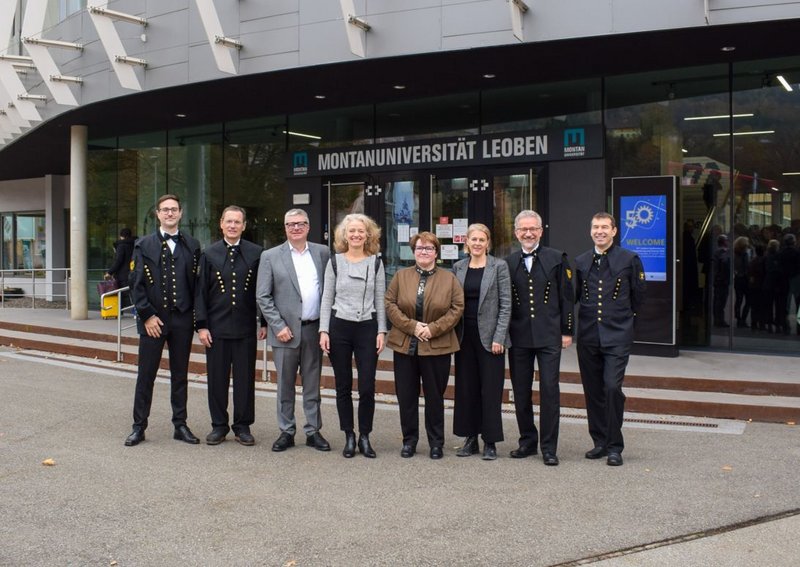
How can we develop high-performance plastic products while keeping materials in circulation? This was one of the questions explored at the 34th Leoben-Conference on Polymer Engineering and Science (LKK 2026), held under the theme “Connecting People – Reinventing Plastics”. The conference was organised by the Department of Polymer Engineering and Science at Montanuniversität Leoben, the Polymer Competence Center Leoben (PCCL) and the Verband Leobener Kunststofftechniker (VLK). Industry talks, research presentations and pitch sessions connected current research with practical applications.
“Whether a plastic is suitable for a given application depends on more than any single material property. We need to understand how materials are processed, how they perform in use and how they can be recycled. The LKK brings together experts who work on these questions across the entire product life cycle,” says Gerald Pinter, Head of the Chair of Materials Science and Testing of Polymers at Montanuniversität Leoben.
Industry experience meets current research
Direct dialogue between researchers and industry practitioners is a hallmark of the LKK. This year’s programme combined Alumni Industry Sessions, in which graduates shared insights from their work in industry, with parallel research and pitch sessions run by the Department of Polymer Engineering and Science and PCCL. Poster presentations and start-up pitches complemented the technical talks, giving emerging research ideas and young companies a platform.
The breadth of applications was reflected in contributions from HEAD and ISOSPORT on high-performance sports equipment designed for recycling, from BMW and Audi on technological challenges in electric mobility, and from AT&S and Lam Research on the role of plastics in electronics and digitalisation. Researchers presented new polymer materials for mobility applications, methods for monitoring material properties and applications of machine learning in polymer engineering.
For PCCL, discussions that connect specific industrial challenges with current research can lay the groundwork for new collaborations. “Progress depends on bringing scientific expertise and industry needs together early on. The conversations at the LKK help us focus our work on questions that matter to industry and turn promising ideas into joint research projects,” says PCCL Managing Director Elisabeth Ladstätter.
The plenary talks placed these technical topics in a broader context. Eva-Maria Kern, President of the University of the Bundeswehr Munich, explored research and innovation for security and resilience. Stefan W. Zangerle of BMW spoke about the transformation of the automotive industry, while Dagmar Glatz of dm addressed the circular economy. Reinhold W. Lang of Johannes Kepler University Linz, President of the Austrian Chapter of the Club of Rome, discussed the role of plastics in sustainable development.
50 years of the VLK connecting students and industry
The VLK’s 50th anniversary was a special part of this year’s conference. At the Alumni Night on 5 November at Live Congress Leoben, the focus was on the career paths of graduates from five decades and the future of polymer engineering and science in Leoben.“For 50 years, the VLK has connected people who put the knowledge they gained in Leoben to work in companies and research institutions around the world. Our network thrives because members share their experience and stay in touch with the next generation. This year’s LKK gives them a chance to do that face to face. Students meet potential employers, and conversations between alumni and researchers can lead to new collaborations,” says David Zidar, Managing Director of the VLK.
POLYMER SCIENCE SCHOOL AWARD recognises young talent
Another highlight was the presentation of the POLYMER SCIENCE SCHOOL AWARD on 5 November. The competition, run by the Department of Polymer Engineering and Science and PCCL, recognises innovative school projects on plastics and polymer engineering. It is open to pupils in grades 10 to 13, who can enter individually or in teams of up to four. The jury looks in particular at the originality of the idea, how clearly the project is explained and the overall presentation of the entry.
First place and a prize of €1,500, supported by Isovolta, went to Niklas Karner, Felix Holzer, Valentin Gentzsch and Maximilian Wieser from HTBLu.VA St. Pölten for their entry, E-Racing Team HTL St. Pölten.
Second place went to Sophie Waldmüller and Felix Mohr from HTL Kapfenberg for their entry, Restfestigkeit (Residual Strength). The €1,000 prize was provided by ZwickRoell.
Third place and a prize of €500, supported by Fiber Elements, went to Philipp Hammer and Jonas Kössler from TGM Wien for their project, MeltMaxxer.
About the LKK
The Leoben-Conference on Polymer Engineering and Science grew out of the Leobener Kunststoff-Kolloquium and is held annually in Leoben. It brings together research institutions, industry partners, alumni, university students and school pupils, helping translate advances in polymer science into practical applications.
Further information
www.unileoben.ac.at/polymerevents/