

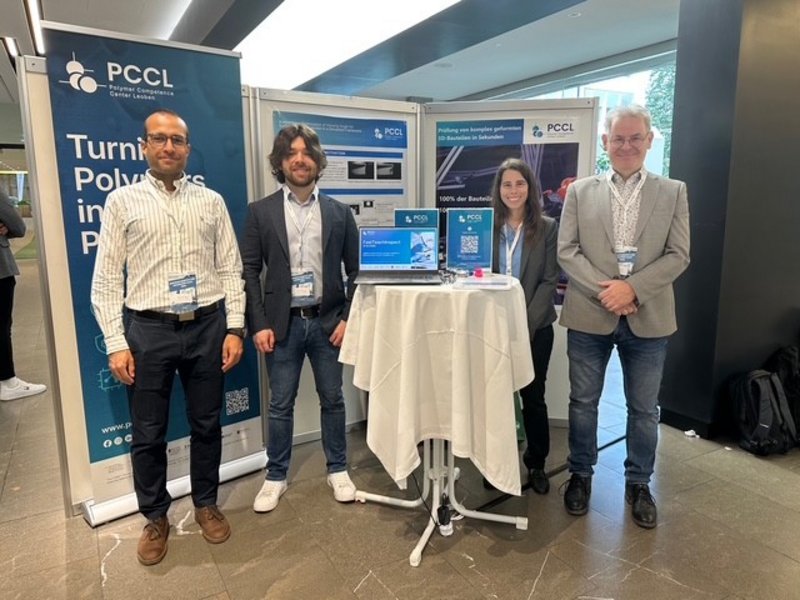
The “Surface Testing, Robot Vision & Artificial Intelligence” division participated with its own stand. Division Manager Dieter P. Gruber and researchers Horst Petschenig, Angelika Hable and Atae Jafari-Tabrizi presented two scientific posters and the COMET research project “FastTeachInspect”. Discussions with industry and research representatives focused on quality inspection requirements and potential collaborations.
New components often require extensive adjustments to existing inspection systems. FastTeachInspect aims to enable automated systems to adapt quickly to new components using just a few samples. The approaches under investigation include robot-guided scanning of complex 3D surfaces and free-fall inspection of functional mass-produced parts.
The project targets: up to 25% less scrap through better differentiation between apparent faults and genuine defects, and up to 50% shorter inspection times compared with manual inspection. PCCL is currently seeking additional industry partners to develop and build inspection demonstrators for their components in production environments.
The viewing angle also determines whether surface defects become visible. The poster “Autonomous Optimization of Viewing Angle for Surface Defect Inspection in a Simulated Framework” therefore investigated autonomous optimisation of the viewing perspective in a simulation environment.
Both approaches aim to make inspection systems more flexible. ERAT provided an opportunity to align research with industrial requirements and establish contacts for future collaborations.
Division Manager Dieter P. Gruber was pleased with the discussions: “We gained key insights for truly application-oriented research and development that keeps pace with current developments and industry requirements.”